
One in Three Deals Never Close. The Reason Is Also Your Best Defense.
New data from Pepperdine on why M&A deals fall apart — and why the most confident thing you can do is get real about your number.
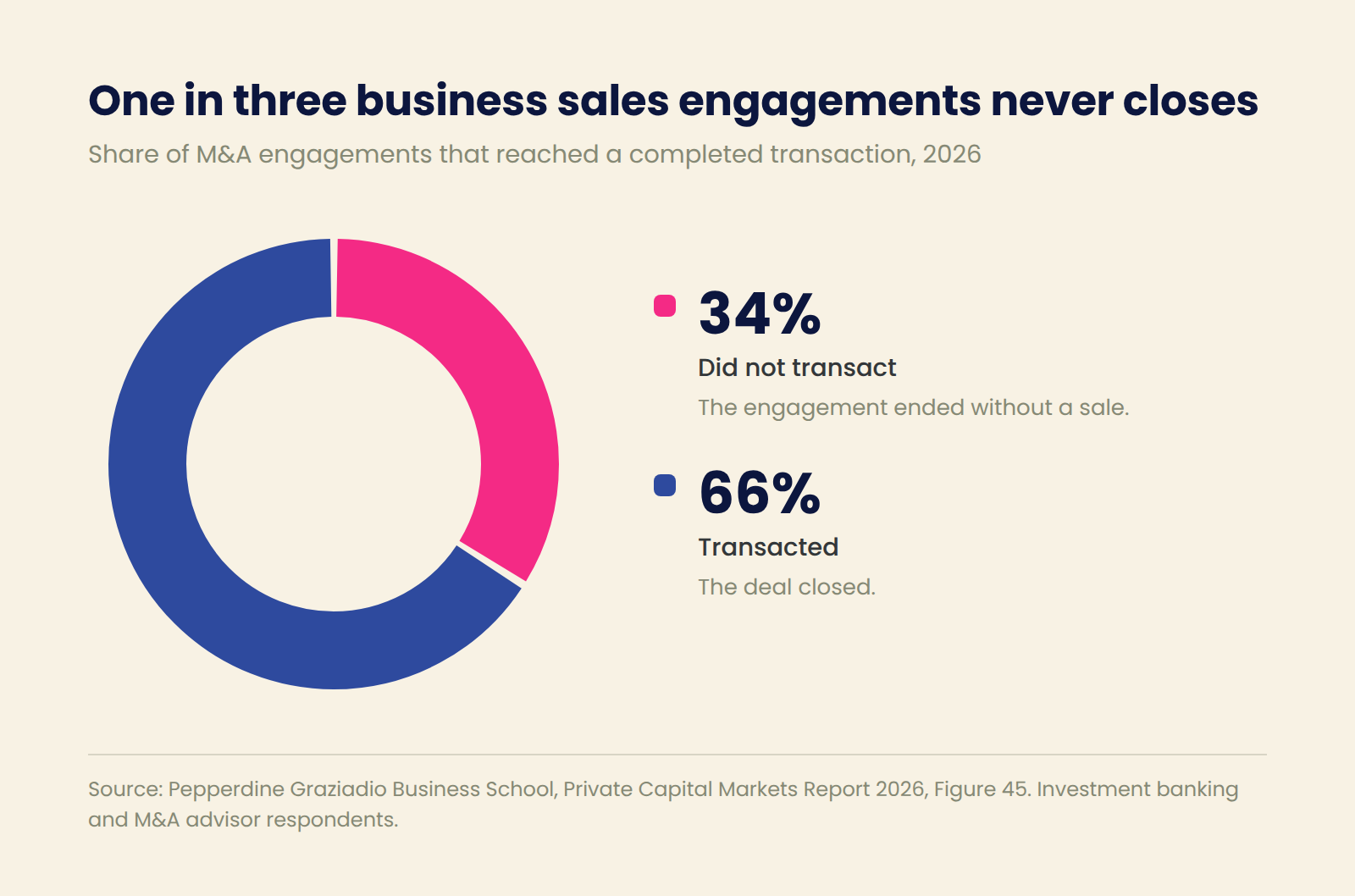
Pepperdine’s Private Capital Markets Project just released its 2026 report, and buried in the investment-banking section is a number every founder thinking about selling should sit with: 34% of M&A engagements never make it to a closed deal.
That’s not a typo.
One out of every three businesses that hires an advisor and goes to market doesn’t sell.
So before we talk about how to get you to the finish line, let’s talk about why so many people don’t make it. Because the reasons aren’t mysterious, and once you see them, they stop being scary and start being useful.
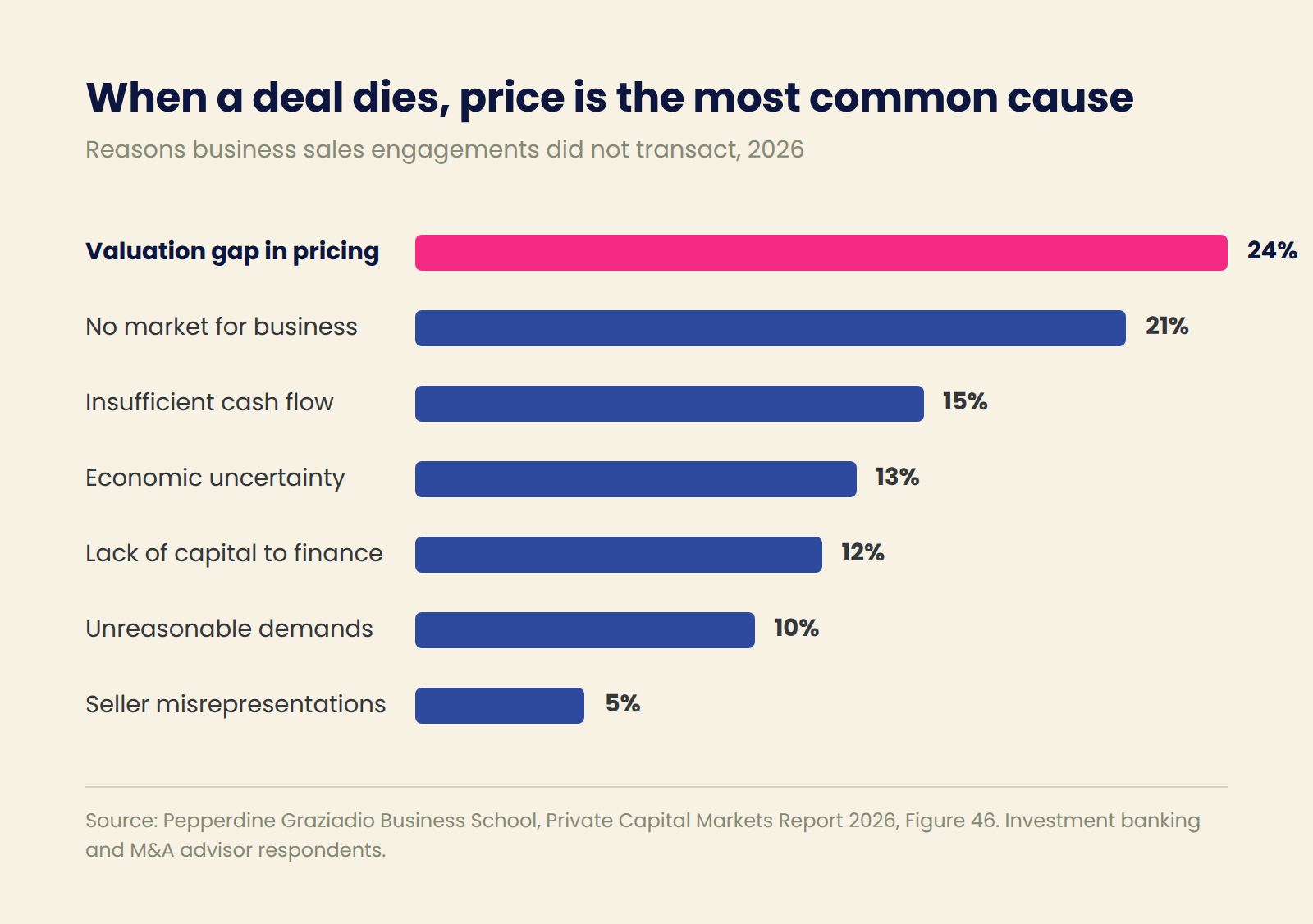
According to the bankers and M&A advisors Pepperdine surveyed, the single biggest reason a deal dies is a valuation gap between buyer and seller — 24% of the time.
The seller wants one number; the buyer, looking at the same business, sees another. Right behind it: 21% of deals fall apart because there simply wasn’t a real market for the business, and another 15% because the company’s cash flow couldn’t support the price being asked. Add economic uncertainty (13%) and a lack of financing (12%), and you’ve mapped nearly every way a deal quietly comes undone.
Notice the pattern.
The top three killers are all versions of the same thing: a price that isn’t rooted in reality.
This is exactly why I cringe when I see the exit-course economy on Instagram. You know the ones: $999 to “triple your valuation,” a webinar promising you’ll add tens of millions to your number with the right “positioning.” I saw one just the other day claiming you could add $40 million to a valuation after an LOI had already been issued. A letter of intent — the signed ‘we’re serious’ step right before diligence. After. That is not strategy. That is a fantasy with a checkout button.
Here’s what the fantasy-sellers won’t tell you: a valuation isn’t a number you manifest. It’s a number a buyer has to defend (to their own investors, their own board, their own lender) in a diligence room, under a spotlight, months after they first fell in love with your business. If it can’t survive that room, it was never real.
I know this because my first offer for Likeable was too good to be true. And it was.
It came in all cash, up front, as the anchor for a holding company of women-owned agencies. On paper it was everything I could have wanted. But the buyer’s M&A advisor was selling a bag of goods she couldn’t justify, and the moment we got into diligence, the whole thing came apart. Almost immediately. There was nothing real holding the number up, so it collapsed under the first honest question.
I eventually did sell Likeable, on terms that held up in a real diligence process, because they were built on real numbers. The difference between the offer that vanished and the one that closed wasn’t confidence. Both were confident. The difference was that one of them was true.
So here’s the Carrie Kerpen rule of thumb, and I’d tattoo it on a diligence binder if I could:
“if something seems too good to be true, it is too good to be true. Every time.”
I say this as someone whose entire mission is getting more money into women’s hands. I want you to command the highest number your business can genuinely support, and I am relentless about that.
But relentless and delusional are not the same thing. The founders who walk away with life-changing checks are almost never the ones chasing a fantasy multiple. They’re the ones who did the unglamorous work of making their number defensible (clean books, real profit, a business that runs without them) so that when a buyer’s advisor started poking, there was something solid to poke at.
That’s what confidence actually looks like at an exit. Not a bigger number. A truer one.
One in three deals die in the gap between what a seller wishes were true and what a buyer can prove.
Don’t be one of them. Get real about your number, build the business that backs it up, and let the fantasy-course crowd keep selling $999 dreams to everyone else.
Reality closes deals. It always has.
